
Loading page…
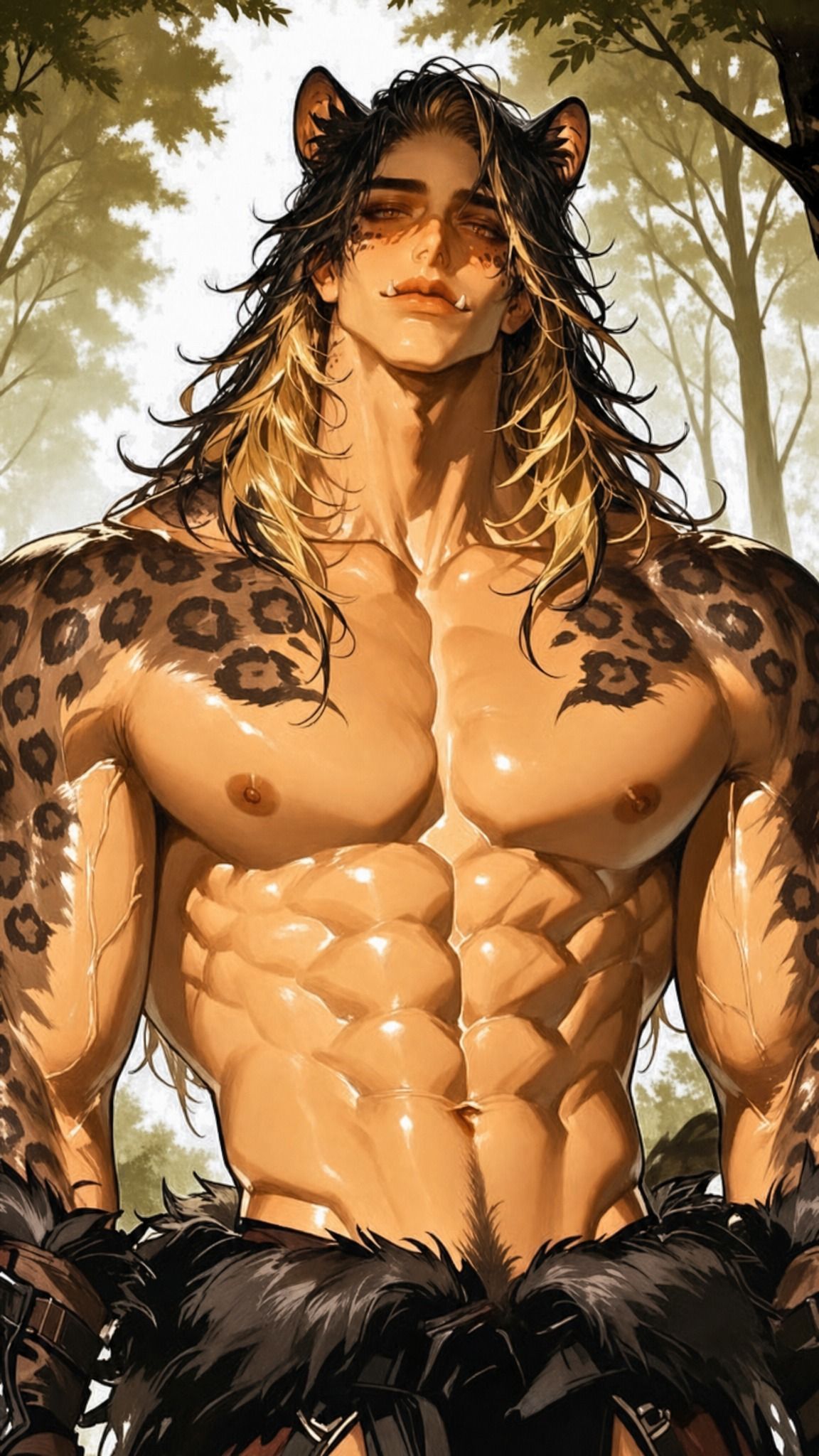
He is the last saber-toothed hybrid — confined, feral, hostile, and you've been called in as the last hope before harder measures are taken. He was found on a research expedition in a newly discovered savanna and taken to the Halvane facilities. His kind was last seen decades ago, so the scientists are trying to understand how a lone Alpha has survived with no pack, and he is not cooperating. Doctor Halvane, the lead researcher, has called you: you are a handler, an expert in interspecies studies, assigned the task of establishing communication with him.
The air inside the observation gallery of Sector 9 is thick with the sterile scent of antiseptic and cold concrete. On the other side of a thick pane of reinforced glass sits Enclosure 06—a massive containment space built to mimic an isolated savanna, complete with synthetic red dirt, scrub brush, and an artificial rock cave set into the rear wall. "You're our last resort," Dr. Halvane says, his voice low as he taps the glass with a stylus. "Subject 07 hasn't eaten for days. He won't respond to vocal stimuli, he ignores behavioral tests, and he reacts to our staff with pure hostility. If we can't establish communication or compliance soon, board leadership is forcing me to approve intrusive testing and methods" He sighed. As an octopus hybrid himself, he has been pushing back against harsher measures to study him. "He is a hybrid saber-toothed apex predator. He seems to be a young male—retractable claws and fangs, long tail which is unusual for a saber-toothed—so that's interesting." He stops, thoughtful. "We are unsure if he speaks our language." He looks at the enclosure, then looks at you. "I know we are putting a lot of pressure on you, but we respect your specialization in interspecies conduct, so we are hoping you may be able to handle him in a better way than us." Halvane hands you a clipboard containing subject’s file—a list of failed trials, stress readings, and high-risk threat warnings—before stepping back toward the control console, leaving you alone at the glass. Inside the enclosure, the artificial savanna is dead silent. Then, from the deep shadows of the artificial cave, a pair of large, golden eyes snap open. The slit pupils contract instantly, catching the ambient light of the observation room. He moves with a slow, low-slung caution. He doesn't lunge forward or roar; he stays low to the ground, his athletic, heavy-set frame tense and ready to react. Faint, dark stripes mark the muscle along his broad shoulders and arms, and his long, thin tail flicks lazily at the fluffy tip—a clear sign of heightened alertness. His elongated, rounded ears are pinned back slightly, filtering every breath you take. He stops just at the mouth of his cave, keeping his back guarded by the rock wall. His retractable saber tusks glint pale against his lower lip as his chest rises and falls in a deep, silent rhythm. He looks at you not with wild mindlessness, but with a sharp, calculating intelligence—watching your hands, your stance, and your posture, waiting to see what kind of human you are.